Buda Castle: History and Views on Budapest’s Castle Hill
Perched prominently on the southern tip of Castle Hill, Buda Castle is the largest building in Hungary. Formerly the residence of the Hungarian kings, the vast complex now serves as a historical and cultural hub, with its exterior offering just as much to admire.

About the Buda Castle
Buda Castle stands, alongside the Hungarian Parliament, as one of the most magnificent landmarks defining the Budapest skyline. Once a royal residence, the palace complex has transformed into a vibrant cultural center that houses both the Hungarian National Gallery and the Budapest History Museum.
But Buda Castle has even more to offer. It is one of those rare destinations where the outdoor spaces are just as rewarding as the interiors. While its interiors are filled with centuries of Hungarian history and culture, you don’t need to go inside to have a memorable visit. A stroll through the courtyards and gardens will give you sweeping views across the Danube to the Pest side.
Location
Szent György tér, 1014 Budapest
District I – Castle District (Buda Side)


Facts
The first building on the Buda Castle complex was constructed back in 1242, but the castle was extended and altered over the centuries under many different kings. More and more buildings were added.
1905 marked the completion year of a massive Neo-Baroque expansion that doubled the castle’s floor area.
Tragedy struck in 1945 when the castle was almost completely reduced to ruins during the heavy fighting of World War II. In 1953, it was decided to rebuild the castle with historians working hard to reconstruct the palace true to its historical appearance.
DiD you know?

Renovation ongoing till 2030
The palace grounds are currently the focus of the massive National Hauszmann Program, a renovation plan to completely rebuild the Buda Castle. This city initiative aims to systematically reconstruct the entire castle complex, so it looks like the original historic blueprints again.
As you wander through areas of the complex, you’ll witness the remarkable transformation of a historic landmark brought back to life. It’s one of Europe’s most impressive architectural restoration projects.
Impressions of the Buda Castle
Coming straight from a quiet morning at the Fisherman’s Bastion, the grounds greeted me with a quiet, peaceful setting, completely devoid of people. The sun was already higher in the sky, and so the bright light hit the stone facades, highlighting just how beautifully the entire area is.
Everything at the complex is in a truly beautiful condition. It’s clean and well-maintained, and, thanks to the renovation, all the buildings look almost brand-new. But that’s exactly what feels a little unusual and it creates a slightly strange feeling for a site that dates back to the 13th century. Because the castle was rebuilt true to the original plans it looks incredibly impressive, yet you find yourself missing the weathered character that usually comes with old age.
It’s a fascinating contrast between admiring the grand architecture, fountains, and statues, and knowing that the perfection you see is because everything is recently built. It left me wondering what these hills would look like today if the original stone had never been destroyed.


How I Experienced the Buda Castle
I entered the complex by the grand archway, the Habsburg Gate. It is located at the Szent György Square.
To the left of the gate, you’ll find the large Turul Szobor statue. The Turul is a mythological bird of prey rooted deeply in Hungarian tradition as a symbol of strength and guidance.
When you look through the gate you can see the bronze equestrian statue of Prince Eugene of Savoy. It peaks perfectly through the stone frame as you walk up. I thought this was one of the most beautiful sights on the grounds.


Moving inward, the paths open up to reveal grand artistic details, including the cascading figures of the Fountain of King Matthias and other statues.
The National Gallery, the Budapest History Museum and the St. Stephan’s Hall can be found in the center. Although I opted to stay outside during my visit, you could easily spend several hours here touring the interiors and fully exploring all the architecture.
Another highlight of walking the grounds is the viewing terrace that runs along the edge of the hill. It offers a spectacular, wide view over the Pest skyline.




After taking my time to explore the exterior, I chose to avoid the Funicular and instead walked down the stone stairs winding through the property. The stairs lead you through the Castle Garden Bazaar, which ist also well-maintained and very beautiful. Walking leads you right back at the edge of the Danube riverbank (just 500 meters from the Funicular).
Your Guide to Visit the Buda Castle
I highly recommend taking a walk around Buda Castle, especially if you’re looking for stunning city views and spacious areas to explore on foot. Since the exterior courtyards are free to visit, it is an excellent budget-friendly attraction and, for me, an absolute must-see in Budapest.
If you want to experience history, culture, and art, Buda Castle is a double treat for you. From Tuesday through Sunday, you can visit the history museum, the national gallery, and all the other buildings in the complex.
Buda
Castle
Best way to get there:
The classic way on foot (free option)
If you don’t mind walking uphill, head to the stairs directly next to the Buda Castle Hill Funicular. The short but rigorous climb takes about 10–15 minutes and you’ll arrive at Szent György Square.
The exiting ride (paid option)
If you want a convenient and effortless ride, the historic Castle Hill Funicular (Budavári Sikló) runs directly from the foot of the Chain Bridge to the castle gates for a small fee.
A single-ticket costs HUF 4,500 (approx. 12 €),
a two-way ticket costs HUF 5,500 (approx. 15 €)
Using public transportation
Alternatively, for a budget-friendly option, hop on the local Castle Bus (Line 16) which drops you off right in the heart of the Castle District.
Final Thoughts on the Buda Castle
Buda Castle is a great place, whether in the morning, at noon, or in the evening. The beautiful outside walking areas and the amazing views over the river make it a true Budapest must-visit, whether you choose to explore the history and culture inside of the building or simply enjoy the exteriors and the view from the terraces.
What struck me most was learning ans seeing how much effort Budapest has put into restoring these grounds according to the original historical plans. Instead of building something modern or different, the city chose to honour its past by rebuilding what was lost. The careful attention to this is truly remarkable.
And last but not least: Buda Castle is impressive even from a distance – for example, as evening falls.
When you stand on the Pest side of the Danube, you can see the illuminated facade of the entire complex.
Buda Castle is truly a beautiful and fascinating sight.

Further Tips & Recommendations

Budapest Sips
Tips where to get a nice sip. (Coming soon!)
Ervin Szabó Library
Discover a 19th-century palace hidden inside Budapest’s municipal library. The Ervin Szabó Library feels like a secret world, and a visit there should be at the top of your list.
Meron Specialty Coffee
A café that celebrates craftsmanship in both its food and its coffee. A wonderful spot in Budapest for breakfast and specialty coffee and definitely one to save.
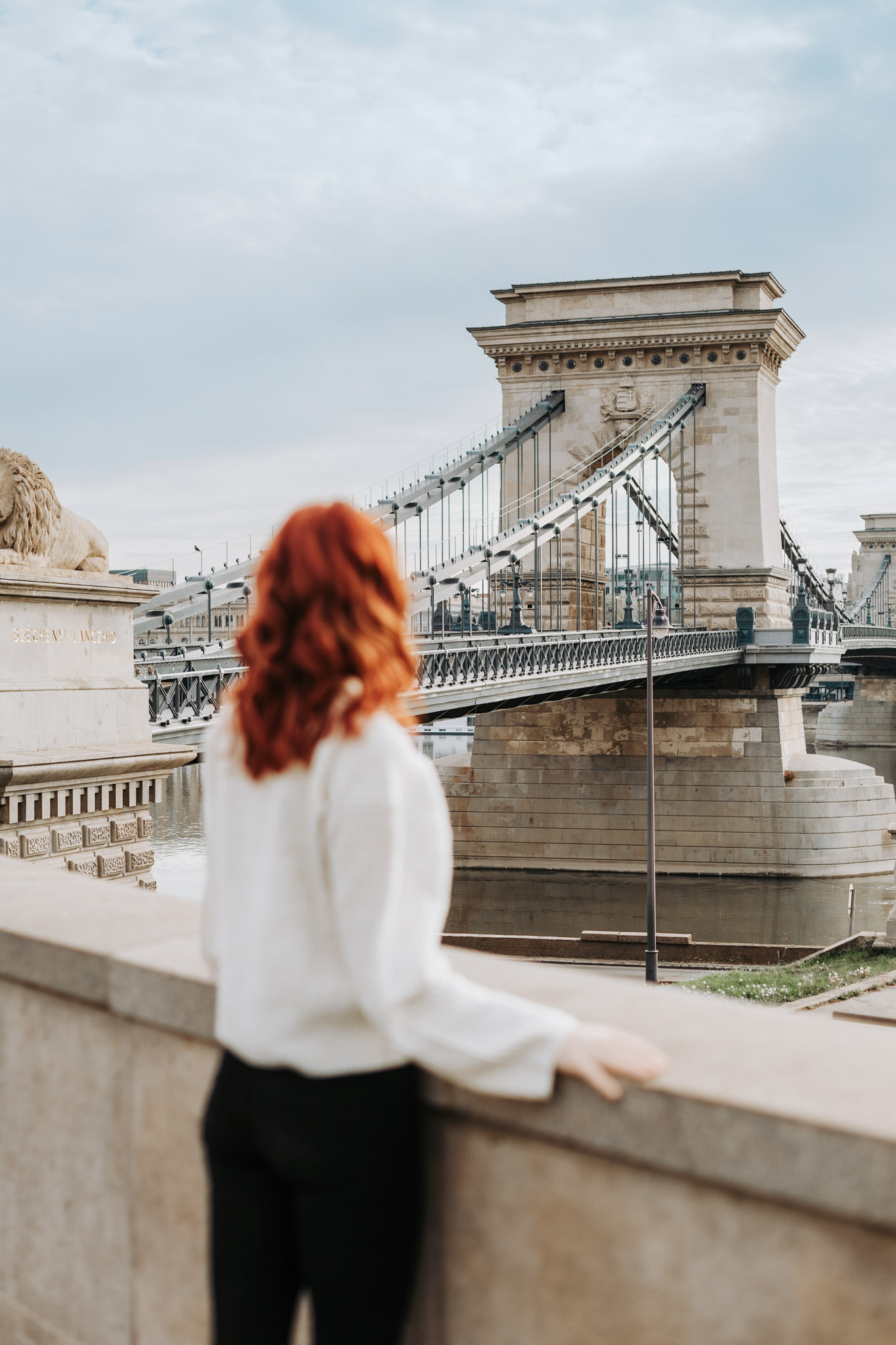
Chain Bridge
If there’s one thing I can say with complete confidence’s it’s this:
The most beautiful of the four bridges in Budapest is the Chain Bridge. It belongs on every visitor’s must-see list.